

Independent software / 2026
Grimório
Build a deck.
Understand every card.
A free, open-source deck builder and testing workspace for Magic: The Gathering.
Find cards that work together, understand why they are suggested, and watch your decks play before you take them to the table.
- My role
- Product design, interface & full-stack development
- Platform
- Windows & Linux · Browser interface
- Project
- Independent · Open source · In active development
01 / The idea
A collection of cards.
A plan that connects them.
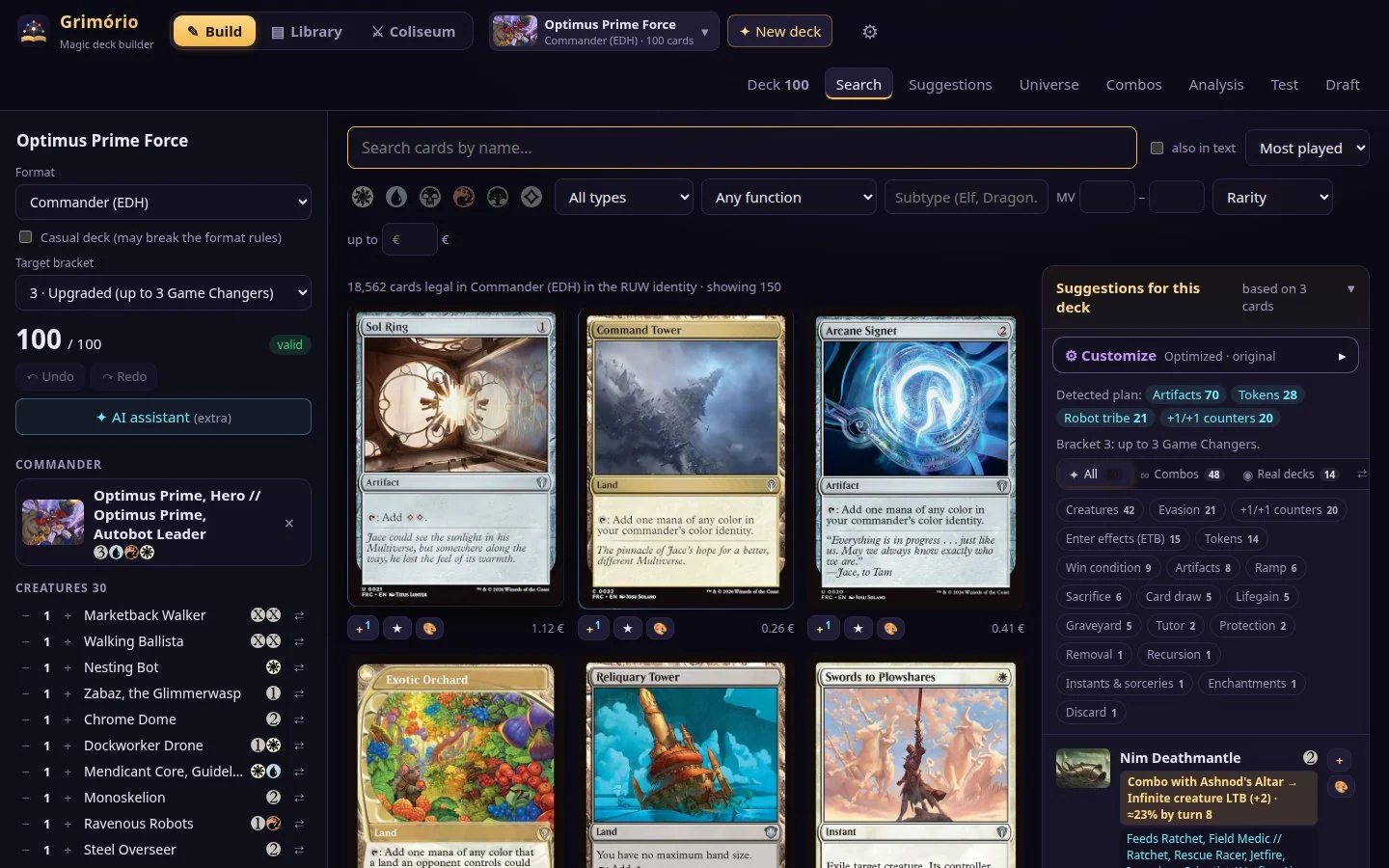
Magic is a card game where each player brings a deck they have assembled. Choosing the cards is part of the game: they need to support a strategy, work together and provide the resources to play them. Grimório brings those decisions into one workspace.
The problem
Card search, deck lists, combo databases and game testing often live in separate places. A recommendation is only useful when you can see what it adds to your deck.
The approach
Connect building, explained suggestions and playable tests. Start with an idea, see the reasoning behind a card, then use game reports to decide what to change.
Build
Start with your idea.
Choose a format and a few cards, import an existing list or build from scratch.
Understand
See why a card fits.
Look at its role, the combinations it enables and the gaps it helps to fill.
Test
Learn from the games.
Watch computer-controlled decks play, review the results and refine the list.
02 / Build & understand
Suggestions
with a reason.
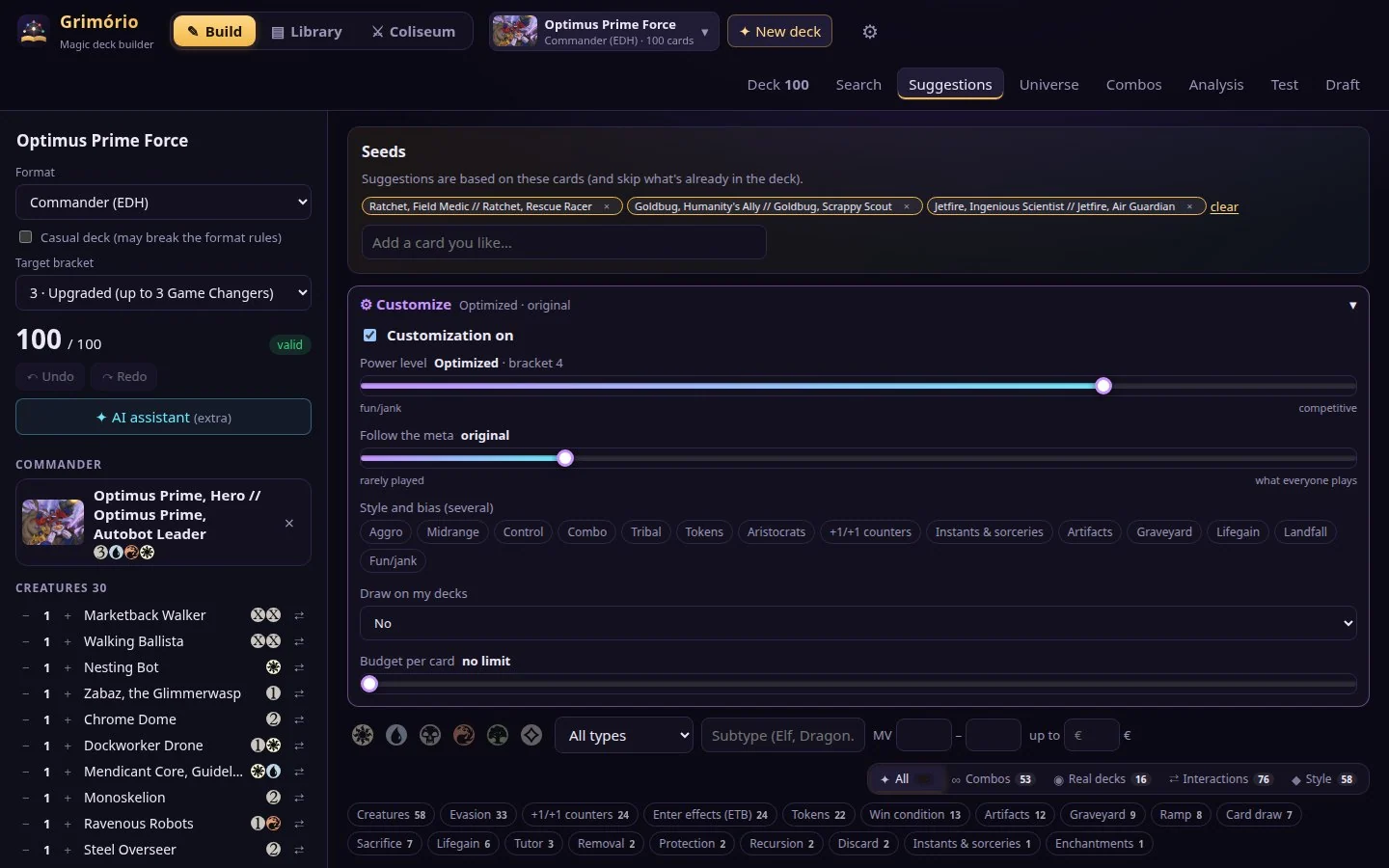
Search by a card’s name, describe what you need in everyday language or filter by its job in a deck. Suggestions connect card text, community deck data and known combinations, with an explanation of how each card fits.
For example: a card might provide more resources, protect an important creature or complete a combination with cards already in the list.
03 / Explore
A different way
to find a connection.
The Universe turns the card catalogue into an interactive 3D map. Explore related cards, see connections to your deck and discover groups of cards used together in tournament decks. The visual view sits alongside the familiar list and search.

04 / Test & refine
Take the idea
into a game.
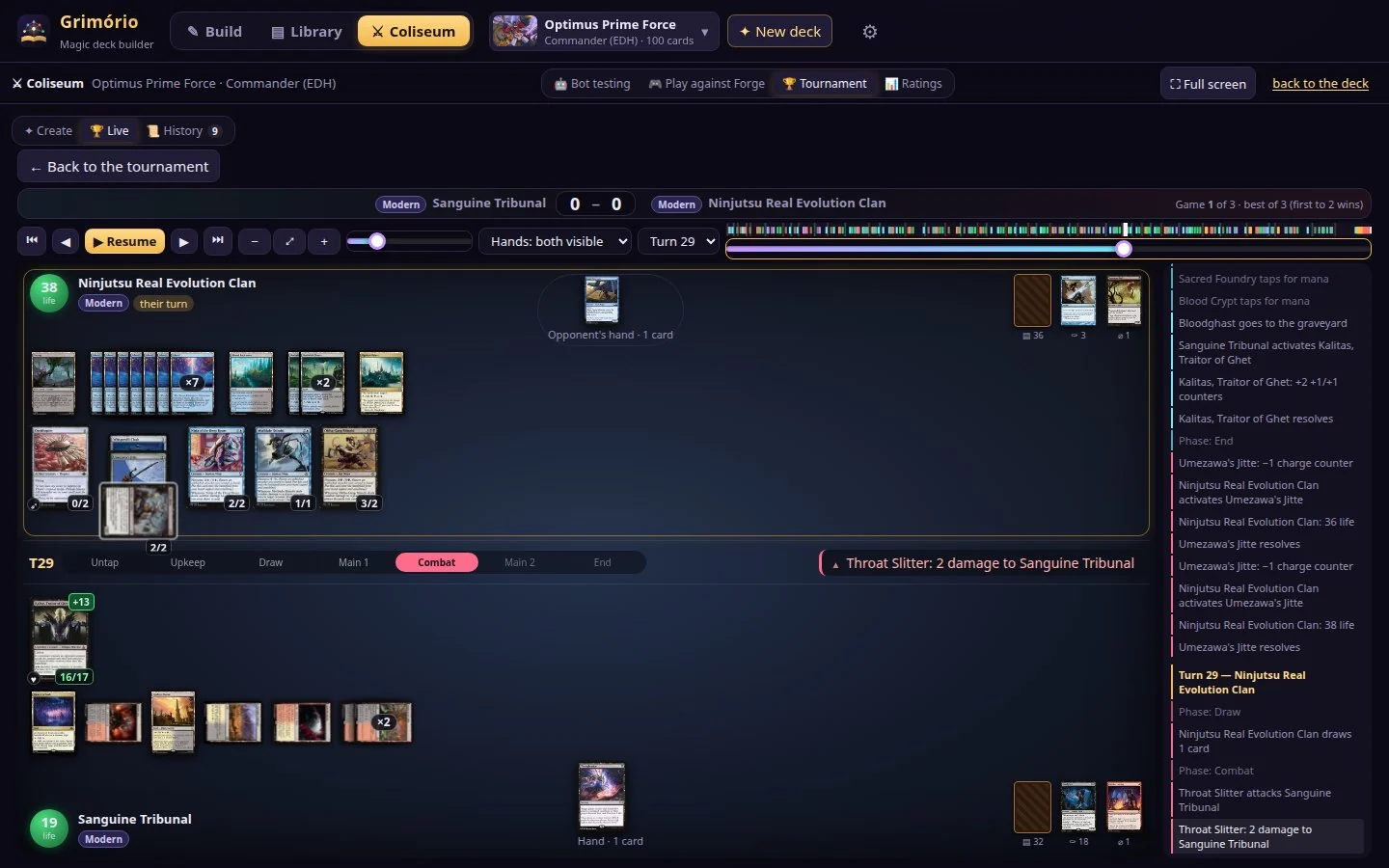
The Coliseum runs your deck against other decks with computer-controlled players. Watch the board, follow the sequence of plays and read the report. Which cards helped? Which stayed in hand? What did the deck struggle against?
The engine behind the games
Real rules. Observable play.
Games run through Forge, the open-source Magic rules engine. Grimório connects it to deck testing, a game viewer, reports, tournaments and ratings. Results depend on the decks and the computer players; they are a tool for exploration, rather than a prediction of tournament performance.
From one test to a tournament.
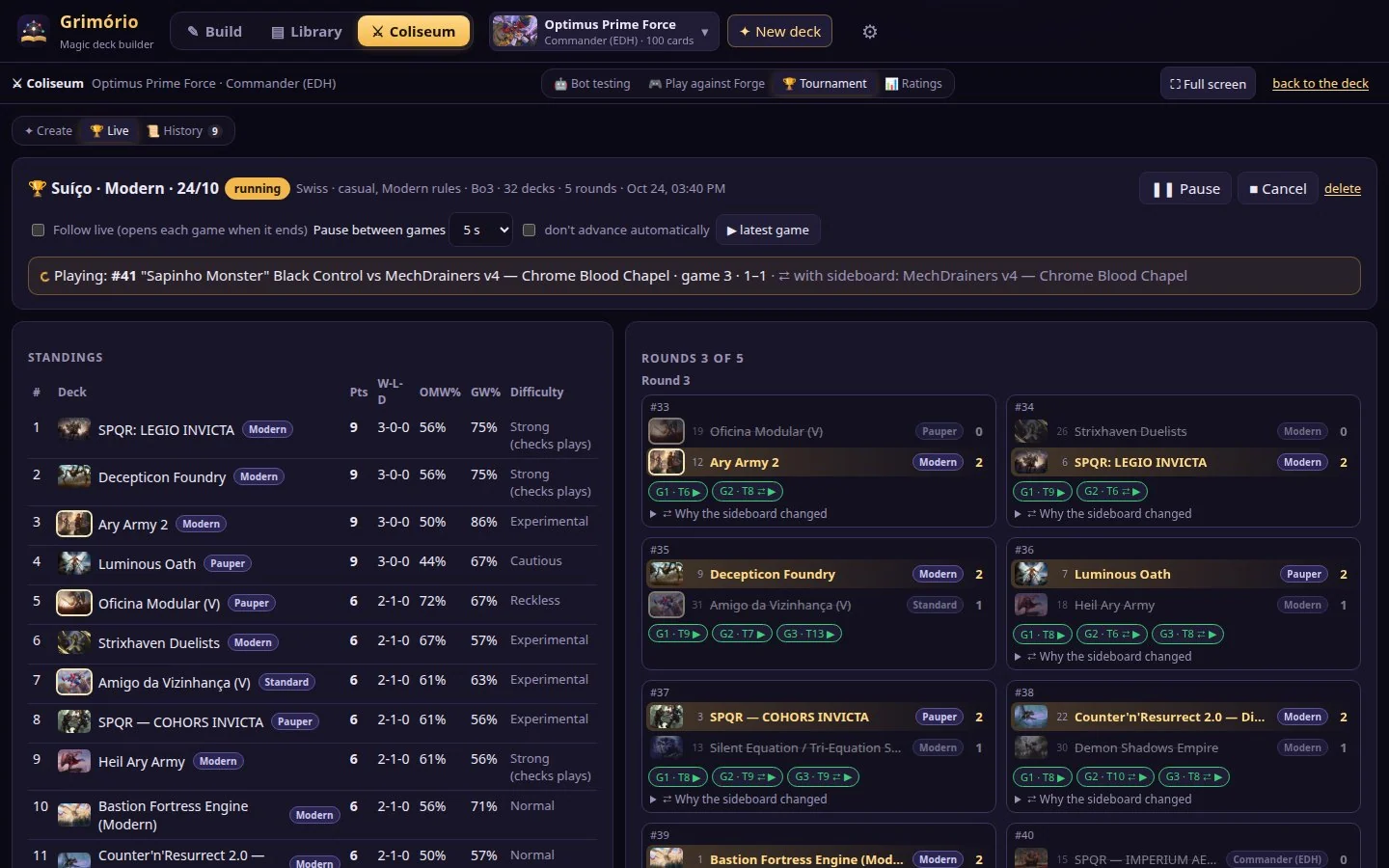
Compare several decks through elimination brackets, Swiss rounds, leagues or multiplayer pods. Follow matches and return to the results.
A library that keeps the context.
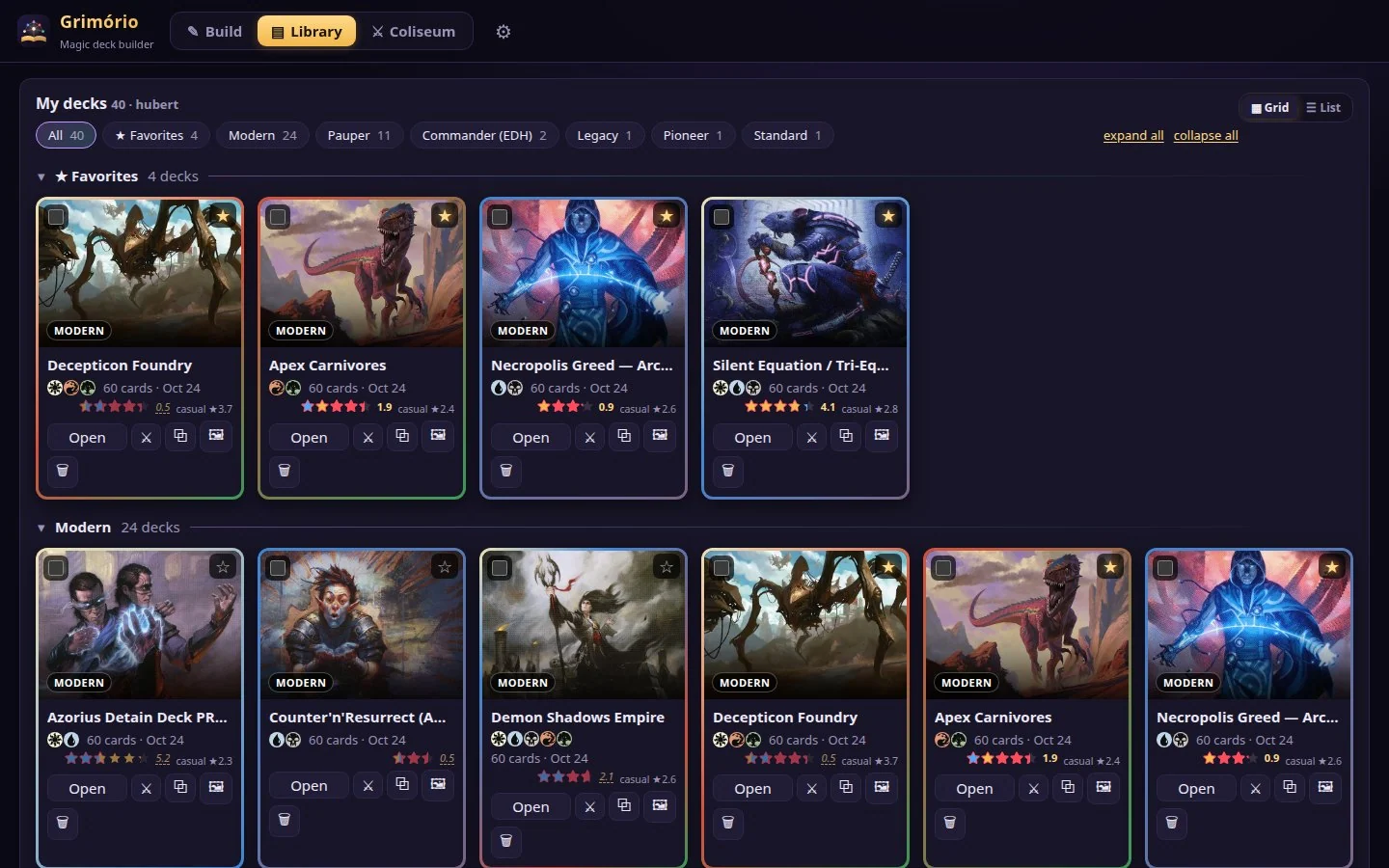
Keep deck lists, covers and ratings together. Separate player profiles let several people share an installation while keeping their own collections.
05 / Inside the project
Designed as a tool.
Built as a system.
I designed and developed the interface, card-data workflows and the application that connects deck building to testing. The visual language pairs a quiet, dark workspace with warm gold accents, leaving the cards and the reasoning in focus.
Grimório runs on your own computer or a home server and opens in a browser. An optional AI assistant can connect to external providers; it is separate from the Forge game engine.
- Interface
- React · JavaScript · Three.js · Vite
- Application & data
- Python · SQLite · Card search and recommendation pipelines
- Game integration
- Forge · Java · Local or Docker runtime
- Card knowledge
- Scryfall · EDHREC · Commander Spellbook · Tournament deck data
- Availability
- Free and open source under GPL-3.0 · Windows and Linux packages on GitHub
All images are actual Grimório interface captures from the project documentation. Open any image for a closer look. Features and installation requirements are documented in the repository.
Grimório is an independent fan project, unaffiliated with Wizards of the Coast. Magic: The Gathering and the card artwork belong to their respective owners. Forge and the card-data services are credited as external projects.