
 Design e Multimédia · Narrativa Visual
2025–26, 2nd semester / Academic projects
IADE / Licenciatura em Design / 2026
Four reels,
one semester.
Two IADE courses, one question: how do images in motion carry meaning? Narrativa Visual asked for stories told through time, silence and voice. Design e Multimédia asked for motion that carries a brand or a series.
Here are the projects I made for both: two short films, an on-air package for a TV channel and an opening title sequence. Every film here was cut by me in Adobe Premiere Pro; the motion work was built in After Effects.
Course 1 / 2
Narrativa Visual
Visual Narrative · Prof. Carlos M. Costa
Narrative as a visual, temporal and sonic construction: characters, space, time, movement, ellipsis, point of view, estrangement. Two films, from a wordless single take to a voice-led story in fifteen shots and more.
Reel 01 · Final project · Individual
Linha 00
Four strangers on the last bus before dawn.
- Length
- 3:00
- Theme
- A luz do dia revela
- Voice
- Portuguese voice-off
- Delivered
- June 2026
«Nas janelas vi coisas que não estavam na rua.»In the windows I saw things that weren’t on the street.
Four people who don’t know each other board the last bus of the night. None of them is lost, yet each seems stuck before a decision. The ride becomes a pause between who they have been and what they might choose next.
At night the story is ambiguous, repeated, fragmented: the same corner comes back twice, then three times; rain turns the glass almost abstract; the windows stop showing only the street. At dawn, what the night only suggested starts to make sense. Lines, reflections and gestures fall into place like a map — and each passenger is still the one who decides how to follow it.
Four passengers,
one shared condition.
Each character was written with a function, a conflict and an object, then built as a Midjourney character sheet so the same face could return shot after shot. The voice-off never says their names: on screen they stay almost anonymous.
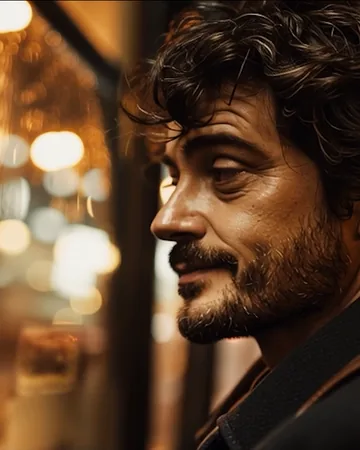
António ValeThe narrator. Postponed creativity; an old leather bag and an unfinished drawing.Criar 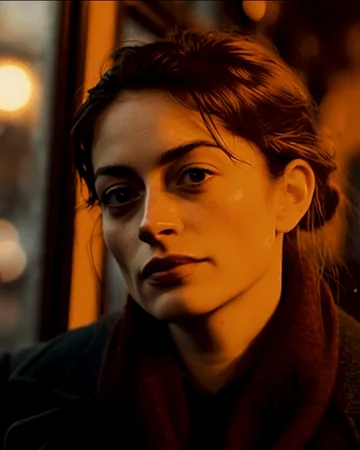
Marta SequeiraThe carer. Looking after everyone but herself; a small medical bag held close.Cuidar 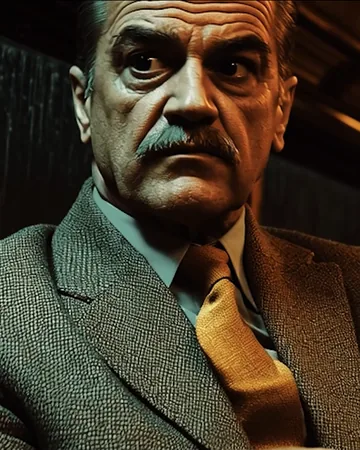
Duarte MontalvãoControl. Rigid, afraid of uncertainty; a briefcase full of contracts.Libertar 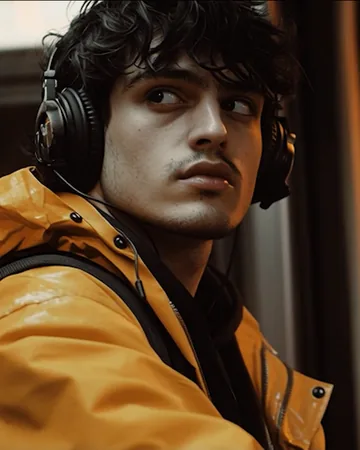
Elias RochaThe youngest. Afraid to begin, curious anyway; yellow raincoat, backpack, headphones.Começar
At dawn four paper tickets are left on the seats: criar, cuidar, libertar, começar — create, care, let go, begin.
Fifteen shots,
night into day.
The brief asked for at least fifteen shots and ellipses in time. Watch the frame: through the night the picture is held in a 2.57:1 letterbox; as the sun comes up, the bars open until the city fills the screen.
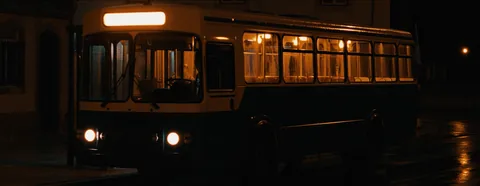
01 · 0:12The last bus, in the rain 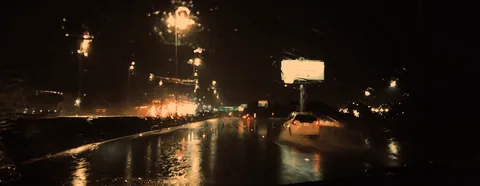
02 · 0:17An empty street, still deciding to wake 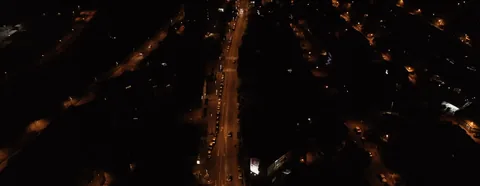
03 · 0:26The city, suspended 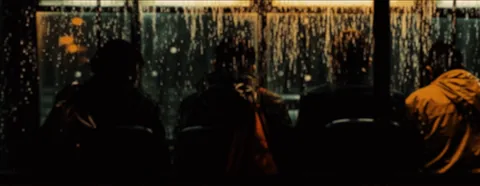
04 · 0:31Inside, there were four of us 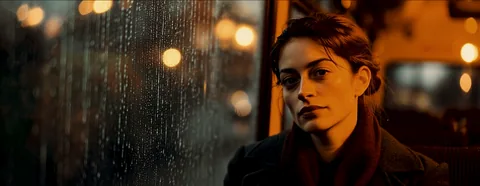
05 · 0:41The woman in the red scarf 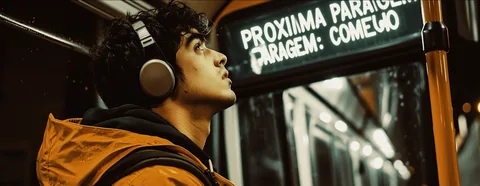
06 · 0:50The boy reading the stops like questions 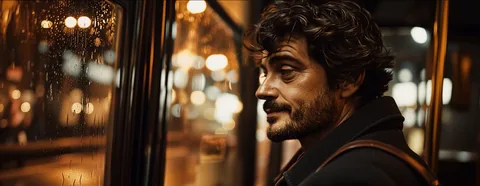
07 · 1:03The narrator 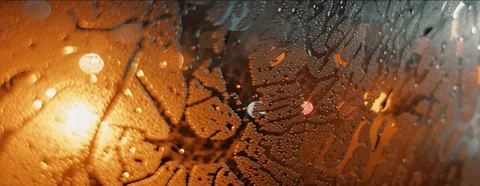
08 · 1:21Rain lines that look like roads 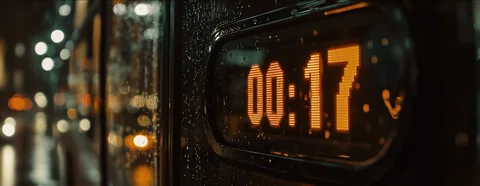
09 · 1:2300:17 — the first ellipsis 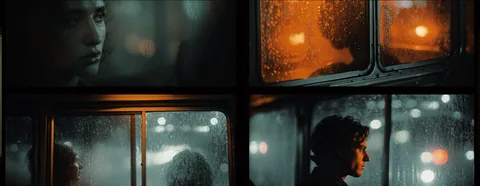
10 · 1:31Looking less outward, more inward 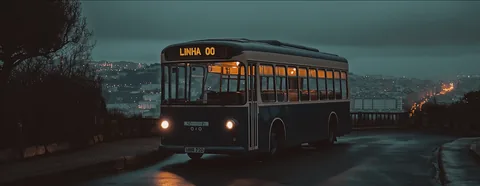
11 · 2:08The viewpoint, before sunrise 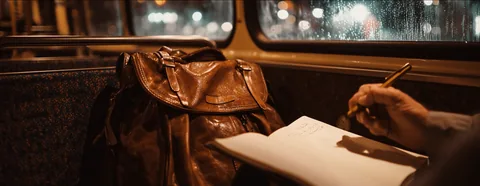
12 · 2:17A hand finishing the drawing 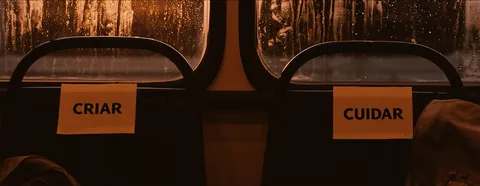
13 · 2:36Tickets left on the seats 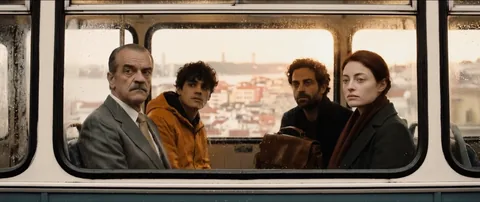
14 · 2:44Morning comes in through the windows 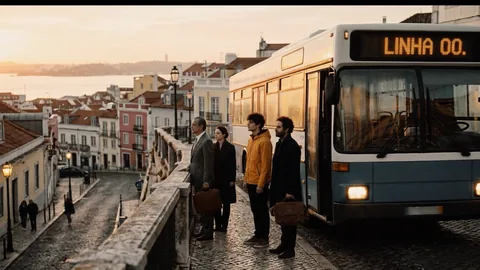
15 · 2:48Full frame: the city appears whole
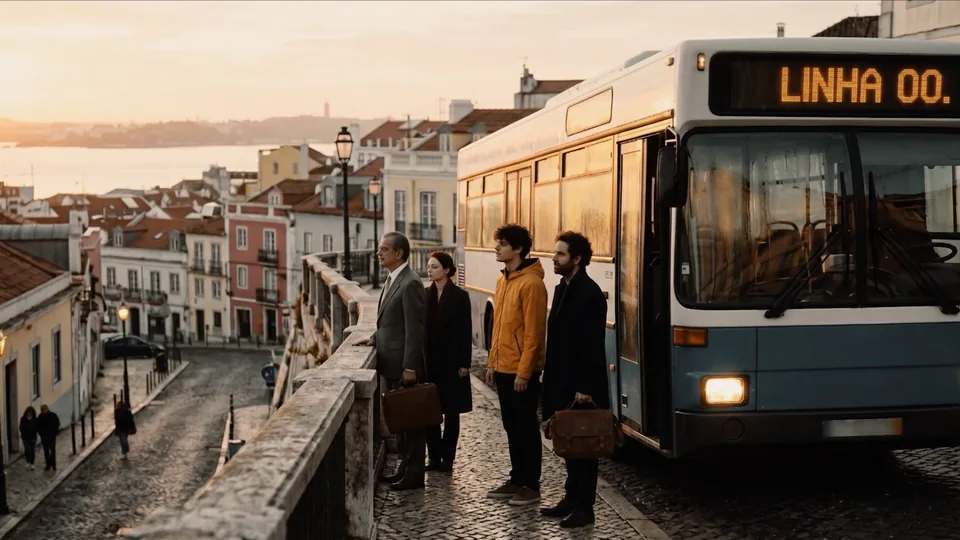
The theme, applied
A noite deu-nos tempo.
O dia mostrou-nos por onde começar.
The night gave us time. The day showed us where to begin.
The closing lines of the voice-off carry the brief’s theme without ever naming it. Daylight doesn’t explain the night; it reorganises it. What looked like noise, repetition or chance turns into a direction — open, not resolved.
How it was made.
Not every effect or 3D element was built from scratch. The job was audiovisual direction in a short time: write, select, generate, order, combine and transform very different material into one coherent story.
- Writing
- Story and voice-off written by me. The narration became the spine of the edit, setting its rhythm and emotional curve.
- Voice & score
- Generated with Suno: a single prompt-engineered output with a calm European-Portuguese narration over a slow, progressive piano.
- Images
- About half from Pexels footage, the rest generated in Midjourney from my visual direction and prompts; a few elements from Artlist and JAI Portal.
- Sound
- Buses, rain inside and out, night traffic, wind and city ambience, mostly from Pixabay.
- Edit & colour
- Adobe Premiere Pro: assembly, transitions, cutting to the music and the voice, colour correction.
Read the voice-off script PT / EN
Entrei no último autocarro porque precisava de chegar a algum lado, mesmo sem saber onde. A paragem estava vazia. A cidade parecia suspensa, como se ainda estivesse a decidir se queria acordar.
Lá dentro éramos quatro. Nenhum de nós parecia perdido, mas todos olhávamos para as janelas como quem procura uma saída. A mulher do cachecol vermelho segurava a mala junto ao peito. O homem de fato contava os minutos no relógio. O rapaz do casaco amarelo lia as paragens como se fossem perguntas. Eu trazia uma mala antiga e um desenho que nunca tinha acabado.
A primeira volta pareceu normal. Depois vi a mesma esquina duas vezes. Depois três. A chuva desenhava linhas no vidro, e por momentos essas linhas pareciam estradas.
Às zero e dezassete ainda éramos passageiros. À uma e quarenta e dois já parecíamos parte da viagem. Às três, ninguém falava. Às quatro, todos olhávamos menos para fora e mais para dentro.
Nas janelas vi coisas que não estavam na rua. Vi uma mão a terminar o meu desenho. Vi a mulher a pousar a mala e a respirar. Vi o homem abrir a pasta e encontrar folhas em branco. Vi o rapaz sorrir para uma direcção que ainda não existia.
Foi então que percebi: aquela linha não nos levava para trás. Também não nos levava para longe. Levava-nos ao ponto antes da escolha.
Quando a manhã entrou pelas janelas, a cidade apareceu inteira. A luz atravessou os vidros, os bilhetes e as marcas da noite. Tudo se alinhou como um mapa. Cada um viu um caminho diferente.
A noite deu-nos tempo. O dia mostrou-nos por onde começar.
I got on the last bus because I needed to get somewhere, even without knowing where. The stop was empty. The city seemed suspended, as if it were still deciding whether it wanted to wake up.
Inside, there were four of us. None of us seemed lost, but we all looked at the windows like people looking for a way out. The woman in the red scarf held her bag close to her chest. The man in the suit counted the minutes on his watch. The boy in the yellow jacket read the stops as if they were questions. I carried an old bag and a drawing I had never finished.
The first loop seemed normal. Then I saw the same corner twice. Then three times. The rain drew lines on the glass, and for a moment those lines looked like roads.
At seventeen past midnight we were still passengers. At one forty-two we already seemed part of the journey. At three, nobody spoke. At four, we were all looking less outward and more inward.
In the windows I saw things that weren’t on the street. I saw a hand finishing my drawing. I saw the woman put down her bag and breathe. I saw the man open his briefcase and find blank pages. I saw the boy smile towards a direction that didn’t exist yet.
That’s when I understood: that line wasn’t taking us back. Nor was it taking us far. It was taking us to the point before the choice.
When the morning came in through the windows, the city appeared whole. The light passed through the glass, the tickets and the marks of the night. Everything lined up like a map. Each of us saw a different path.
The night gave us time. The day showed us where to begin.
Script as written in the production plan; the narration in the film was generated from it.
Linha 00
Autor: Hubert Dungen
UE-IADE 2025–2026
Reel 02 · Project 1 · Group work
A Aldeia
Adormece
A card game that swallows the room. (The Village Falls Asleep)
- Length
- 1:45
- Theme
- Noite Misteriosa
- Form
- One continuous take, no words
- With
- Samuel Silva
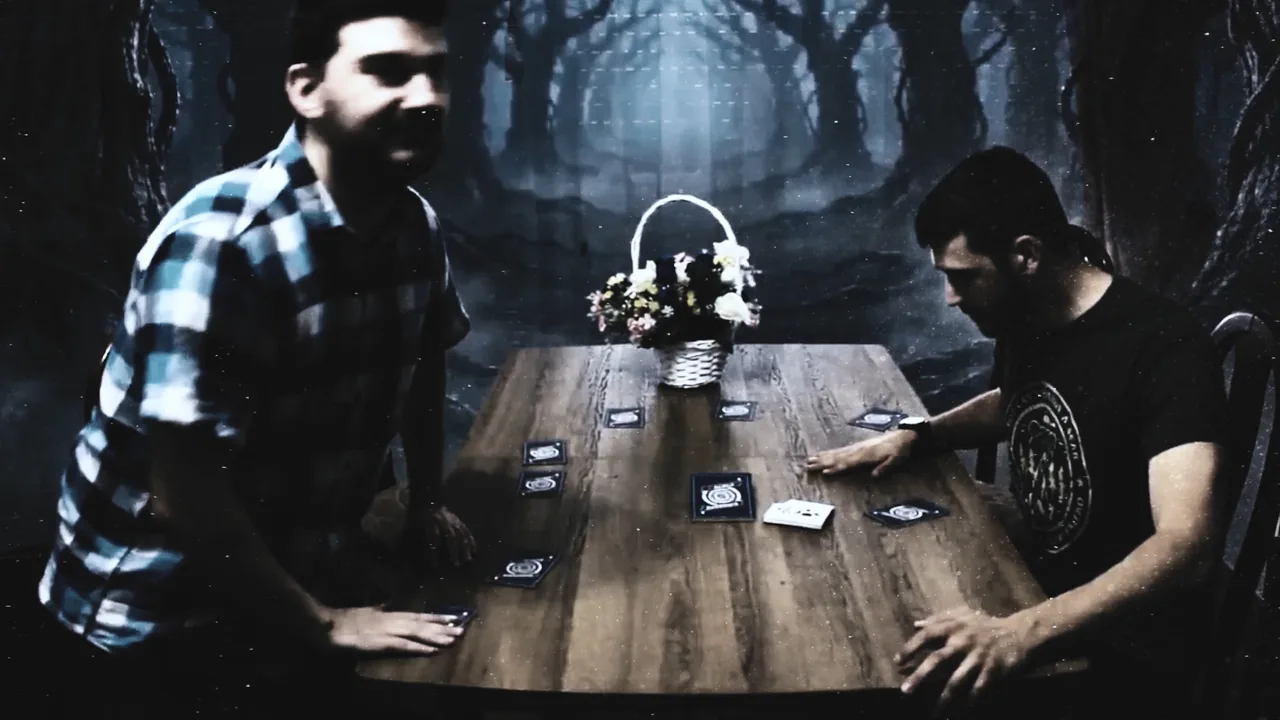
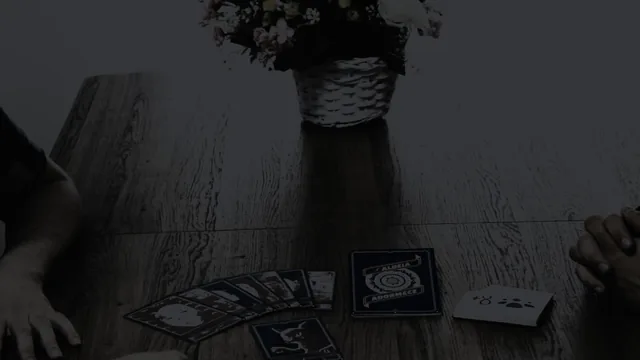
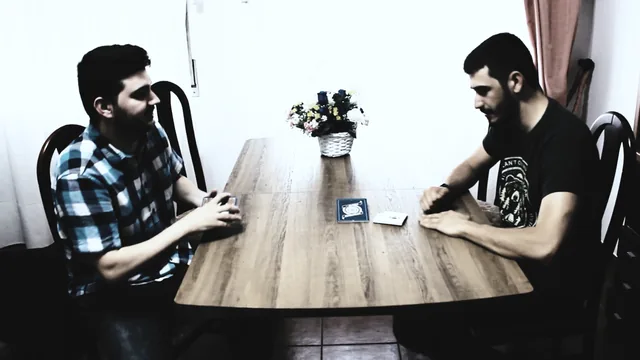
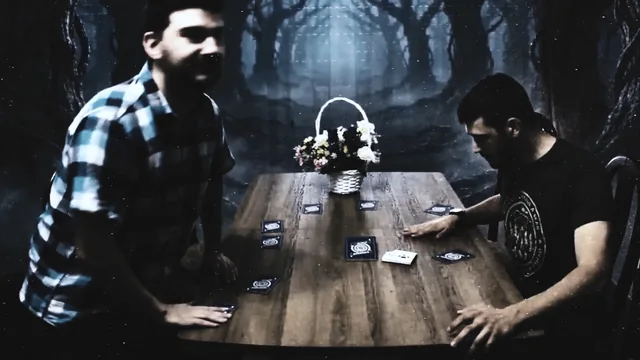
Two players sit down to a game of villagers and werewolves made for more than eight.
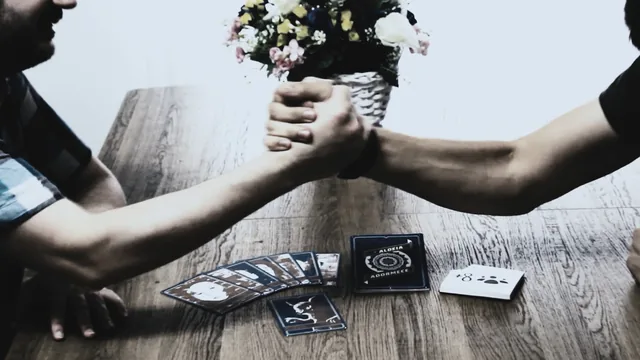
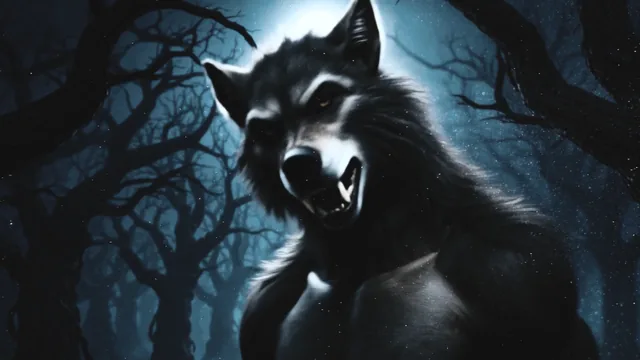
Cut down to two — the brief allowed only two characters — the game turns from a group’s suspicion into a direct, claustrophobic duel. The cards stop being props: they reveal hidden identities and set off a slow transformation of the room and of the bodies in it.
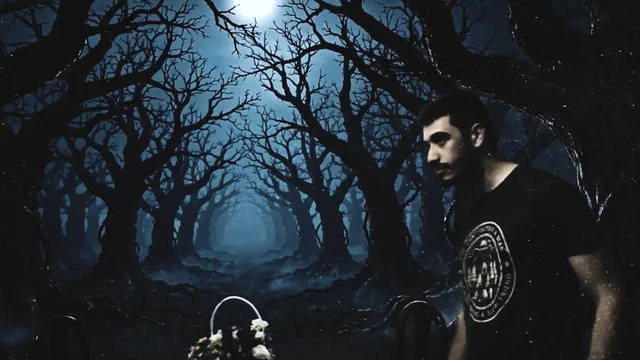
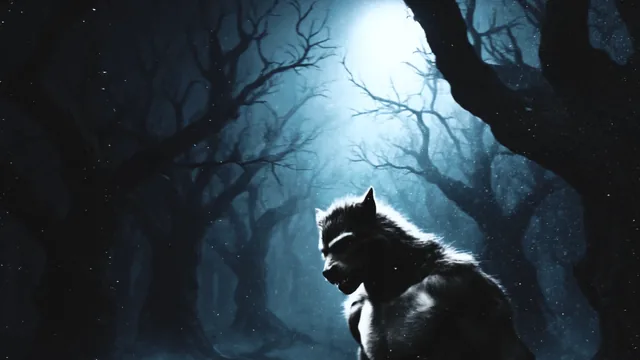
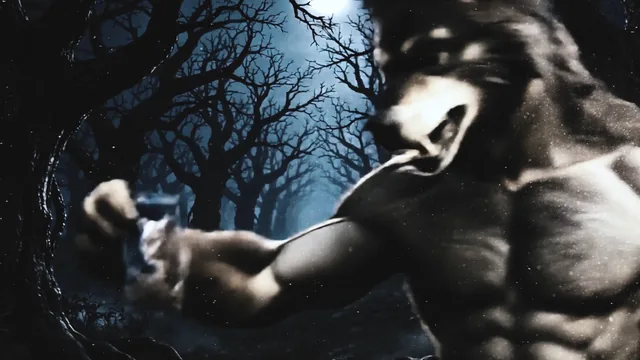
The light shifts, the TV breaks into interference, and the living room turns into a dark, cursed forest. The villager tries to run, only to find himself in the middle of a swamp — and the door is gone. Only when the werewolf shows his card does the villager get away. The game, played as fiction, has leaked into the scene.
Two players,
two hidden roles.
Without dialogue, the conflict is drawn between the two bodies: one holds the vulnerable position of the villager, the other slowly becomes the threat. Turn the cards.
One take,
scrubbed.
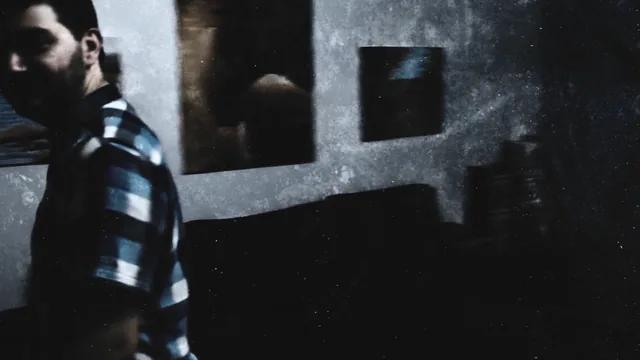
The logic of the sequence shot meant the room could never cut away — it had to transform. The choreography left room for discreet transitions so that each change of intensity still reads as one continuous time and space. Drag along the take.
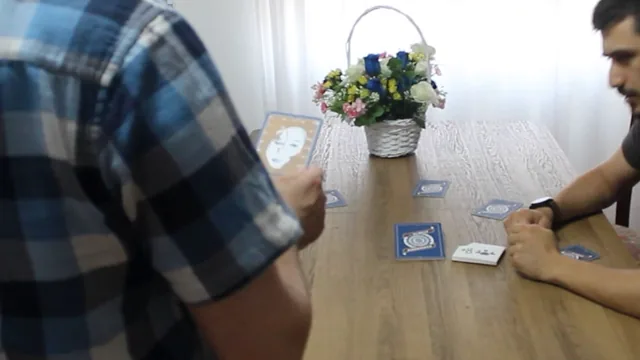
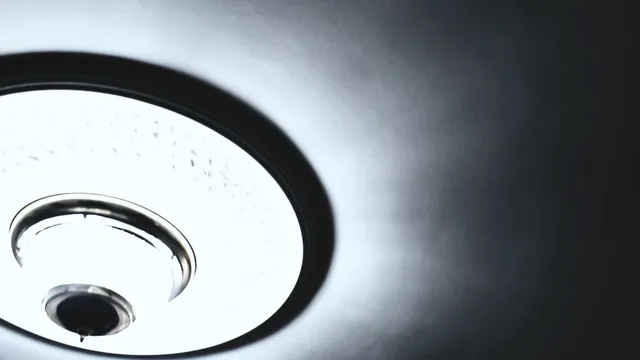
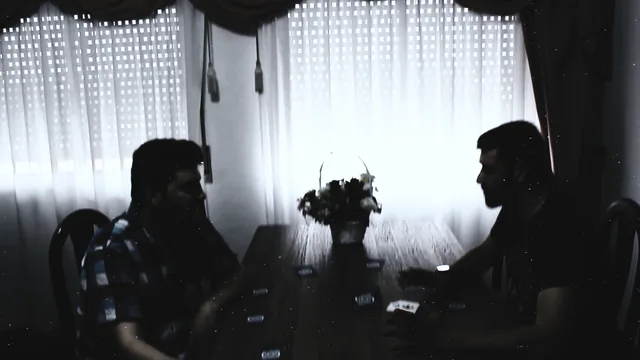
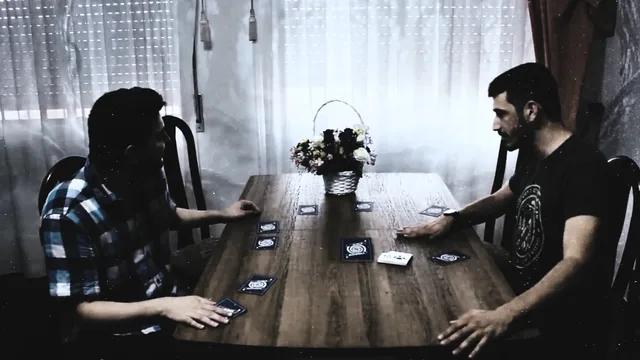
Made in one living room.
Tatiana Vieira filmed it with her Canon camera on a tripod, in Samuel’s living room, which became the whole set. Samuel and I performed it, with close attention to continuous movement, the bodies in the space and the dramatic build.
I edited the film in Adobe Premiere Pro — continuity, rhythm, transitions, image against sound — and used AI-assisted editing for the passages that needed effects: the supernatural atmosphere and the werewolf transformation. The music was generated with Suno; the sound effects come from Pixabay.
A Aldeia Adormece
- A film by
- Hubert Dungen & Samuel Silva
- Idea & concept
- Samuel Silva
- Video editing
- Hubert Dungen
- Camera
- Tatiana Vieira
- Cast
- Samuel Silva, the villager
Hubert Dungen, the werewolf - Music
- Generated with Suno
- Sound effects
- Pixabay
UE-IADE 2025–2026
Course 2 / 2
Design e Multimédia
Multimedia Design · Prof. Rui Lança
Motion graphics, title design and broadcast identity, built mostly in Adobe After Effects and finished in Premiere Pro. A channel package and a title sequence.
Reel 03 · Project 2 · Graphic package for a TV channel
O Portal
Infinito
National Geographic’s yellow frame, opened into a door. (The Infinite Portal)
- Channel
- National Geographic
- Pieces
- 4 × 10 seconds
- Formats
- 1920×1080 · 1080×1920
- Presented
- May 2026
The rectangle stops being a border and becomes a passage.
The brief: choose an existing channel, renew its on-air package and add an Instagram Story that ties the channel to a commemorative day and the UN Sustainable Development Goals. I didn’t rebrand National Geographic. I kept its most recognisable asset — the yellow rectangle — and changed its role: a three-dimensional portal, the bridge between the brand’s four worlds.
The look rests on contrast: the dark void of space against the colours of the planet, with negative space kept clean for schedules and captions.
Cosmos 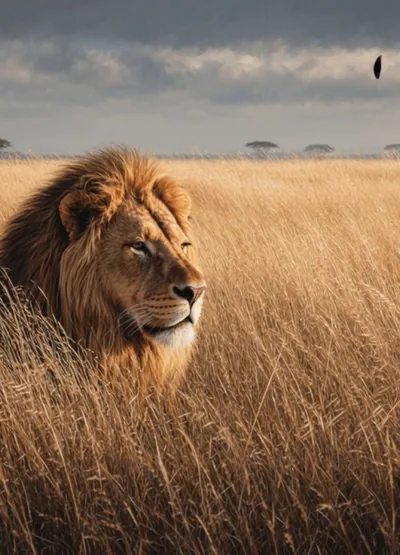
Animal nature 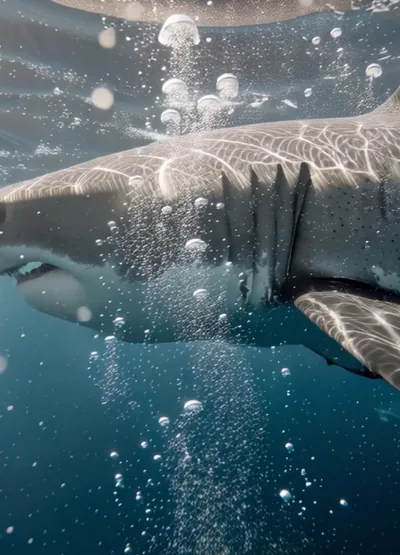
Oceans 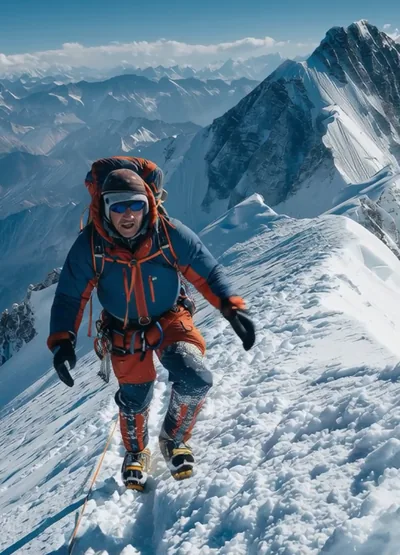
Human nature
On air.
Four finished pieces, ten seconds each. Press play on any monitor; the tally light shows what’s live.
Drawn first.
Every piece began as a hand-drawn storyboard: orange arrows for the camera, the portal as a small rectangle growing out of the dark. The boards also cover the programme line-up separator and the lower-third system.
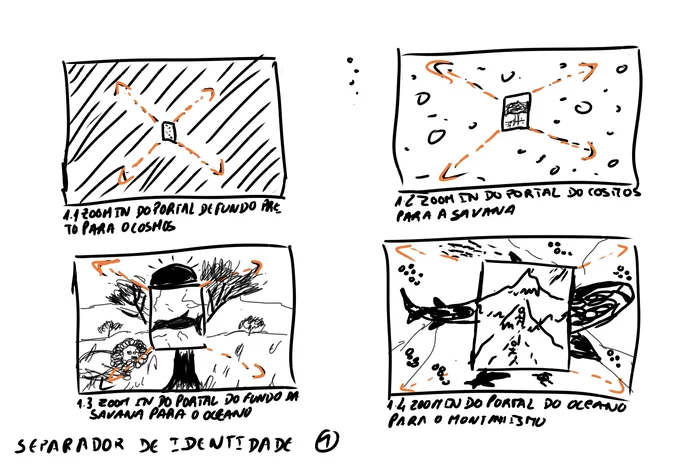
01Identity ident · page 1 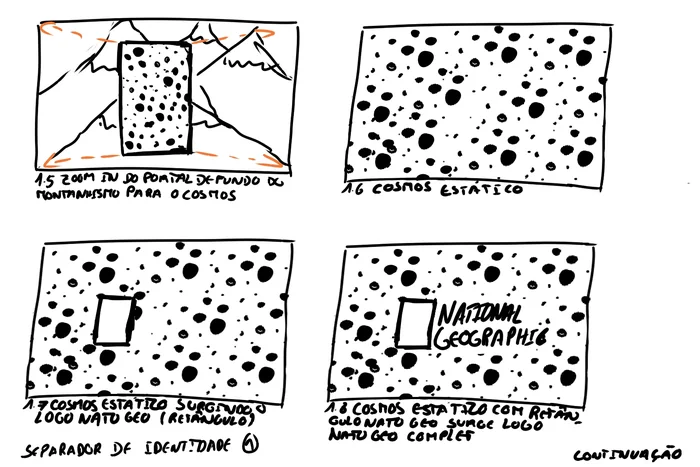
01Identity ident · page 2 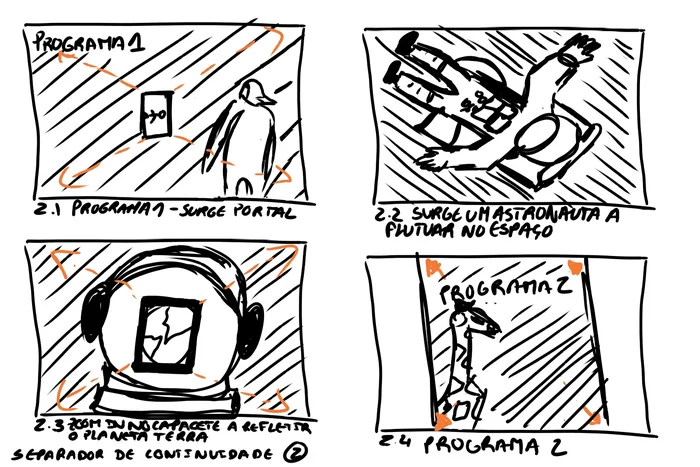
02Continuity ident 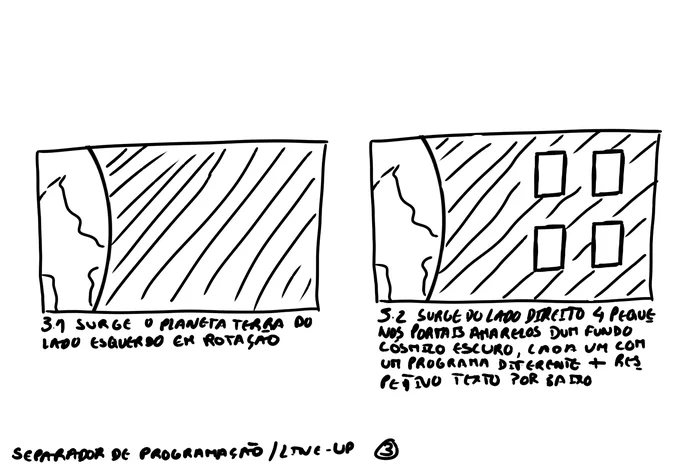
03Programme line-up separator 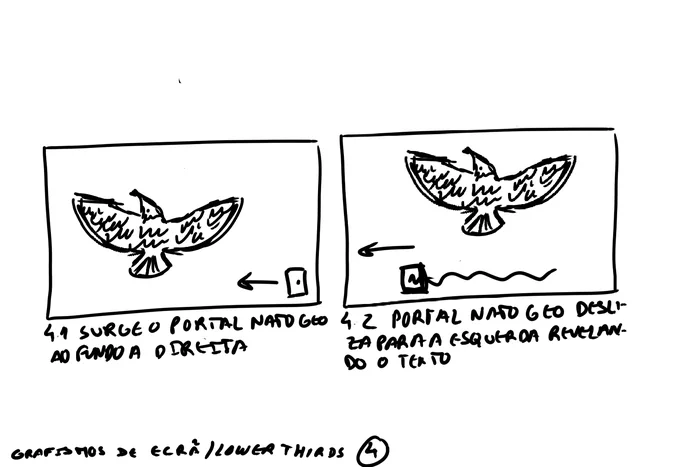
04Lower thirds 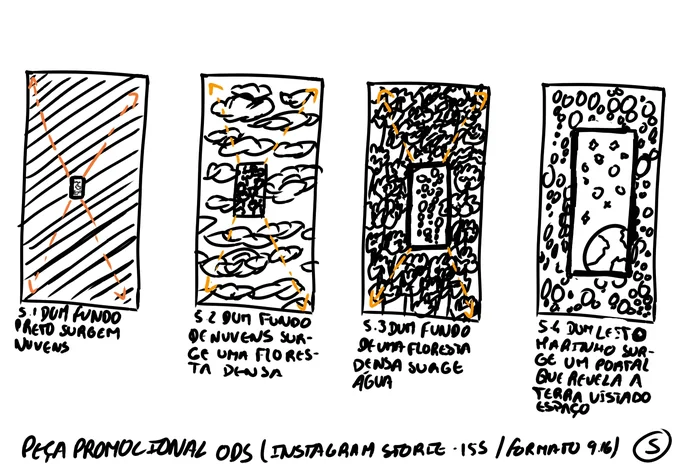
05Instagram Story · Earth Day
- Imagery
- Part of the raw material generated in Midjourney (V8.1, photoreal / cinematic), with Pexels footage for the eagle and the African penguins.
- The portal
- After Effects: track mattes cut the portal illusion; Z-position and scale on a 3D camera give the depth of the dive.
- Finish
- Premiere Pro for assembly and an immersive sound design, with effects from Pixabay.
Academic proposal. The National Geographic name and logo belong to their owners; this package was not commissioned by the channel.
Reel 04 · Project 1 · Opening titles for a series
A Química
da Entropia
Five seasons of Breaking Bad, distilled into one minute of rising disorder. (The Chemistry of Entropy)
- Series
- Breaking Bad
- Length
- 1:10
- Tools
- After Effects · Premiere Pro
- Brief
- 30–60 s, title + director + 3 actors
Entropy: the measure of disorder in a system.
The brief asked for an animated opening title sequence for a film or series of our choice: 30 to 60 seconds that carry its concepts and atmosphere, with the title, the director and at least three actors. I used entropy as the visual and sonic metaphor for the protagonist’s transformation — from a placid chemistry teacher to Heisenberg’s collapse — and told it purely through the rhythm of the edit.
An exponential
curve of tension.
Four acts of fifteen seconds. The cuts start slow and accelerate; time remapping ramps the speed inside the shots, forcing the eye to process too much, too fast — until a cut to black at 59 seconds, where only the title survives.
-
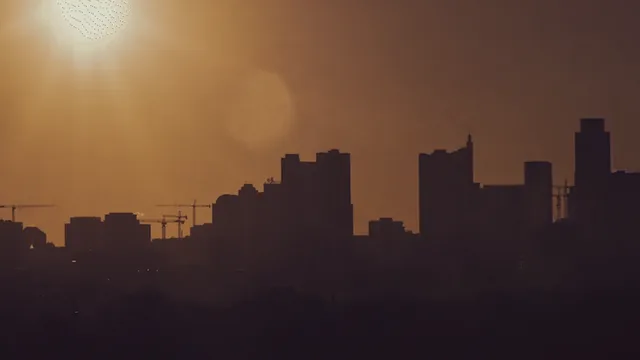
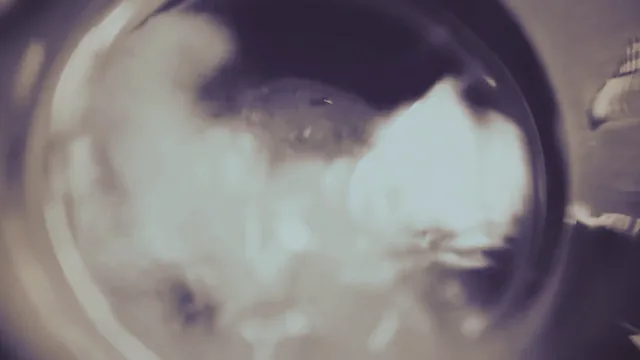
I · 0–15 sInertia
Everyday inertia, broken by imminent danger. Slow, measured cuts; a beige, desert, neutral palette.
-
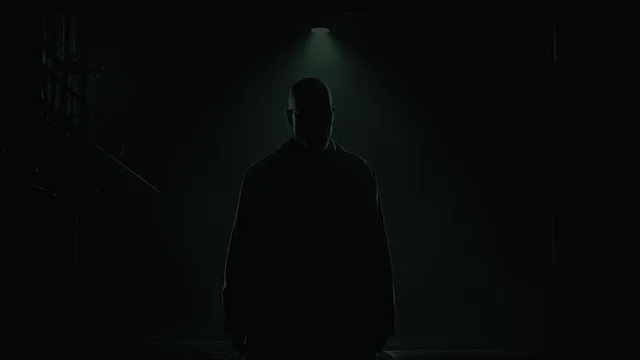
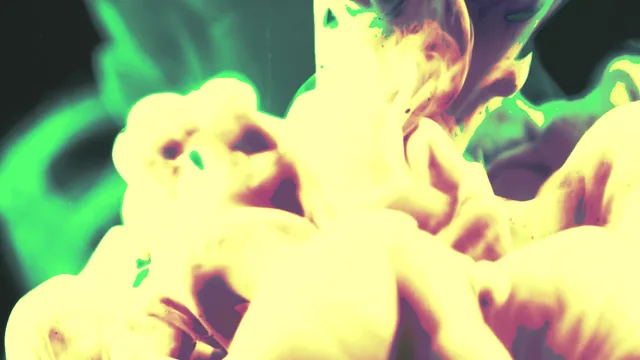
II · 15–30 sReaction
The toxic catalyst. Shorter, crossed cuts; toxic yellows and synthetic greens.
-
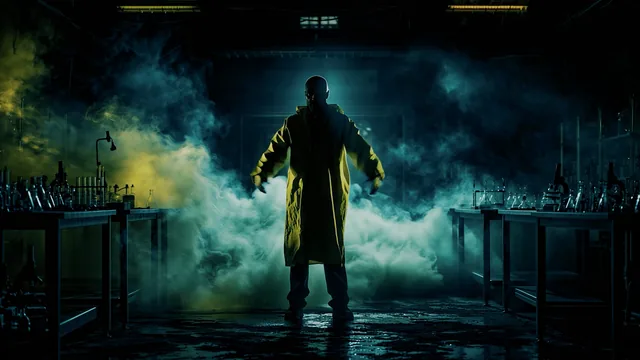
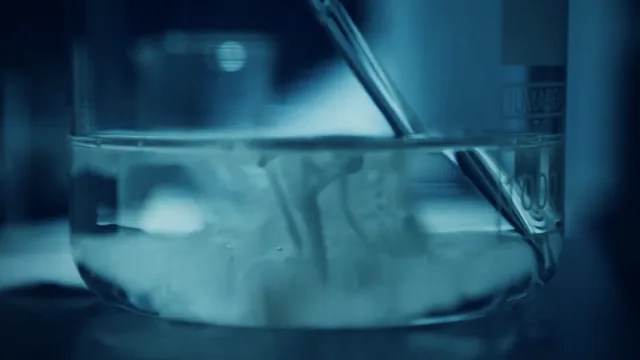
III · 30–45 sControl
The weight of the empire, the illusion of absolute control. Oppressive cross-dissolves; dark green, black, anthracite.
-
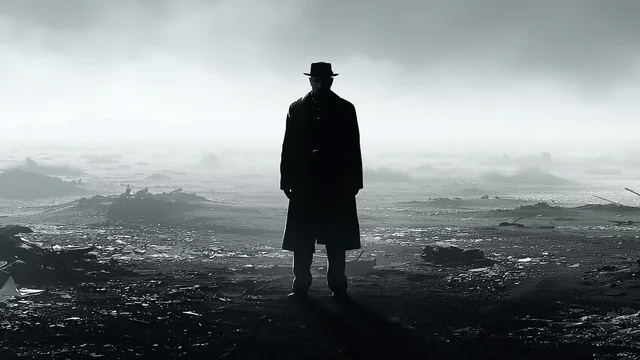
IV · 45–60 sEntropy
Sensory collapse: a burst of grey flashes, then the cut to black. Isolation, total loss.
- Masks
- Rotoscoping and pen-tool masks isolate the figure.
- Double identity
- Multiply and Screen blend modes at 50–70% opacity embed the persona in the lab equipment — one ghost, one frame.
- Time
- Time remapping with ramped interpolation accelerates the shots exponentially.
Non-commercial fan title sequence made for an academic brief. Music: Dave Porter — “Cleaning House”, “Parking Garage Standoff” and “Aztek”, from the Breaking Bad original score. Includes a shot from the series. Breaking Bad and its music © AMC / Sony Pictures Television and their respective owners.